AI Agents Development
Business process automation with AI agents tailored to the way you work.
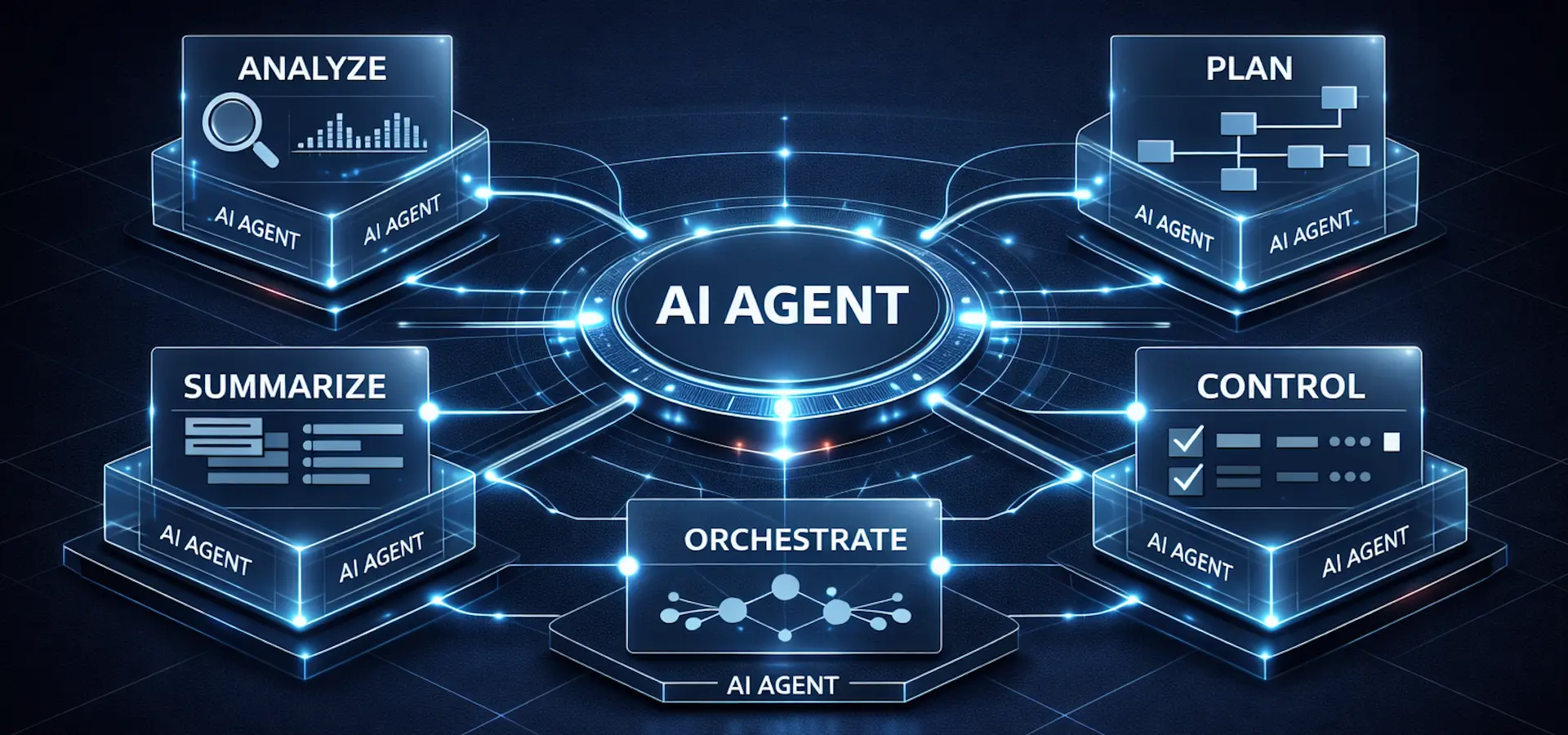
AI is now present almost everywhere, yet in business it is still often used superficially — through fragmented tools and isolated features that create the impression of progress without fundamentally changing how a company operates.
Real value emerges only when AI takes on a concrete role within a business process. Not as an add-on that generates content or automates a narrow task, but as a system that helps process information faster, guide workflows, reduce team workload, and bring structure to daily operations.
This is precisely the role of AI agents. They can analyse incoming data, identify the type of request, trigger the next step in a process, assign tasks, and monitor whether everything is proceeding according to defined logic. In more complex implementations, multiple agents can collaborate to cover entire operational workflows and become an integral part of the business infrastructure.
For us, an AI agent is not a chatbot that merely “sounds intelligent,” but a system that executes clearly defined operational steps: it reads input data, makes decisions within predefined rules, initiates the next action, and hands tasks back to humans when judgment, approval, or exception handling is required.
Its value is not measured by the number of generated messages, but by the time it saves, the number of manual steps it eliminates, and the level of control it restores to the team.
A Solution That Adapts to Your Business
There is no universal AI solution that works equally well for every business. Every company has its own processes, rules, tools, and friction points where time, focus, and operational capacity are lost every day.
That is why we do not approach AI agent development as the implementation of a ready-made template, but as the creation of a solution tailored to the real needs of the business. In some cases, this means automating one clearly defined part of a process; in others, it means building a broader agent-based system that takes over multiple interconnected tasks.
Such solutions can play an important role in sales, inquiry handling, administration, internal coordination, documentation workflows, and other operational areas that are essential to a company’s daily functioning.
It is equally important to emphasize the opposite: this service is not the best fit for companies that do not yet have stable processes, clearly defined responsibilities, or reliable data sources. In those situations, the operational logic and data foundation need to be put in order first — and only then should AI agents be introduced.
Who Is AI Agent Development For?
AI agent development is designed for companies that want to improve business processes, reduce operational workload, and enable faster, more structured execution of daily tasks.
It is especially valuable for businesses that:
- handle a large volume of inquiries, requests, or internal tasks on a daily basis
- operate processes involving multiple steps, multiple people, and multiple business tools
- spend too much time on manual data handling, checks, and internal coordination
- want to speed up operations without increasing headcount proportionally
- want greater control over statuses, deadlines, and task execution
- want to standardize the way work is done and reduce dependence on improvisation
These solutions deliver the greatest value to small and medium-sized businesses that want to grow without allowing operations to become slower, more complex, and harder to control.
What Do You Gain from Implementing AI Agents?
Implementing AI agents does not simply give you a new feature or another tool within your existing system. It gives you a more efficient way of working, more clearly defined processes, and less dependence on manual handling, repeated checks, and internal back-and-forth of information.
The most common benefits include:
- faster processing of inquiries, requests, and internal tasks
- less manual work in repetitive processes
- less operational chaos and less time lost to coordination
- better visibility over statuses, deadlines, and execution
- more consistent execution of standard process steps
- greater capacity for growth without a proportional increase in internal workload
We do not measure the success of implementation through vague “AI activity,” but through concrete operational metrics: request processing time, number of manual interventions, processing accuracy, number of exceptions, response speed, team workload, and consistency of process execution.
What Does This Look Like in Practice?
1. Lead Qualification and Sales Preparation
In sales, an AI agent can automatically process new inquiries coming from web forms, email, or campaigns, assess their potential, and prepare the next step for the sales team.
Instead of manually reviewing each lead, checking data, and deciding who to contact first, the agent can identify the type of inquiry, extract relevant information, match it with existing CRM records, and suggest prioritization. Based on predefined rules, it can create a sales opportunity, assign the contact to the responsible person, and prepare a draft response or next action.
The sales team spends less time on administration and more time engaging with leads that have real business value.
2. Processing Financial and Administrative Documents
In administration and finance, an AI agent can take over the routine processing of incoming documents such as invoices, purchase orders, confirmations, or contracts.
Instead of manually transferring data into business systems, the agent can extract key information, verify completeness, compare it with existing records, and prepare entries for ERP or accounting systems. If it detects inconsistencies or rule violations, it escalates the case to the responsible person for review.
This reduces manual workload, speeds up document processing, and minimizes operational errors.
3. Customer Support and Service Request Handling
In support operations, an AI agent can handle the first layer of customer requests, enabling faster and more consistent resolution.
When a user submits a request, the agent can identify the topic, urgency, and issue type, link it with existing data, and immediately provide relevant guidance or open a ticket with a pre-filled summary. Simple and repetitive inquiries can be resolved automatically, while more complex cases are routed to the appropriate team member with full context.
The result is faster response times, reduced pressure on support teams, and better visibility into request statuses.
4. Internal Coordination and Task Management
AI agents can also bring significant value to internal organization, especially in environments where tasks are distributed across multiple people, teams, and tools.
Instead of managers manually reviewing messages and requests to assign priorities, the agent can analyse incoming inputs, classify tasks, assess urgency, and assign them according to predefined rules. It can also track deadlines, send reminders, and flag delays or bottlenecks.
This approach reduces operational chaos, accelerates coordination, and improves visibility over execution.
5. HR and Candidate / Employee Request Handling
In human resources, an AI agent can assist in processing large volumes of job applications, internal requests, and administrative tasks.
For example, it can analyse incoming applications, extract key information from CVs, group candidates based on defined criteria, and prepare structured overviews for the HR team. Similarly, it can route internal employee requests — such as questions about documentation, procedures, or onboarding — to the appropriate channels automatically.
HR teams gain more time for interviews, evaluation, and people-focused work, while spending less time on repetitive administration.
6. Operations, Logistics, and Execution Monitoring
In operational workflows, an AI agent can monitor whether processes are running according to plan and react when deviations occur.
It can track order statuses, delivery deadlines, internal work orders, or the execution of specific process steps. If it detects delays, missing data, or process blockages, it can automatically send alerts, trigger the next action, or involve the responsible person.
This is particularly valuable in environments where processes must run accurately, transparently, and without unnecessary interruptions.
Which Systems Do AI Agents Typically Integrate With?
AI agents deliver the greatest value when they are connected to the systems where work already happens. That is why they are most integrated with business systems, web applications, administrative interfaces, databases, CRM and ERP solutions, forms, document workflows, and other operational tools.
In practice, implementation is often built on top of:
- business systems and web application development
- administrative and management interfaces
- CRM, ERP, and CMS integrations
- databases and document management systems
- UX/UI design of operational screens and dashboards
- ongoing maintenance, optimization, and system evolution
Only when these components are properly connected can an AI agent system become a reliable and valuable part of a broader digital ecosystem.
How Do We Approach AI Agent System Development?
A high-quality implementation does not start with technology, but with a clear understanding of the business process that needs to be improved.
Process Analysis
The first step is to understand how the business operates today. We identify bottlenecks, repetitive tasks, points where the most time is lost, and where an AI agent can deliver real operational value.
Defining Logic and Scope
Next, we define what the agent should do, which information it uses, which tasks it takes over, and where human control must remain. At this stage, we place strong emphasis on data security and responsible AI usage rules.
System Architecture Design
We plan how the agent system will integrate with existing tools, data sources, business rules, and operational workflows. This includes selecting the most appropriate models and technical approach based on real usage context.
Development and Integration
Once the structure is defined, we develop the solution and integrate it with the systems the company already uses, ensuring the agent becomes a functional part of the business infrastructure.
Testing and Optimization
Before deployment, we test how the system performs in real-world scenarios, refine the logic, and establish clear rules for edge cases, exceptions, and human validation.
Deployment and Continuous Development
After implementation, the system is continuously monitored, adjusted, and further developed as needed. When appropriate, we introduce it gradually — starting with a pilot scenario or a single process and expanding into a broader agent-based system over time.
AI Agents That Truly Improve Business Performance
Developing AI agents only makes sense when the result is not just another tool, but a better organized, faster, and more efficient way of working.
When properly designed, AI agents can take over tasks that currently consume team time unnecessarily, slow down execution, and create additional operational strain. The result is not just more automation, but more structure, more control, and more room for growth.
If your organization relies on processes that are constantly repeated, require too much manual work, or make it harder to execute day-to-day tasks quickly and consistently, there is a strong chance that an AI-based solution could deliver real business value.
If your team spends too much time on repetitive tasks, manual processing, and internal coordination, an initial process audit can clearly show where an AI agent would have real impact, where it would not make sense, and what should be tackled first.
List of related services


Our approach
Our approach to AI agent development is focused on what matters most to businesses — less manual work, less operational chaos, and more efficient processes. We do not build AI agents as isolated functionalities, but as solutions introduced precisely where a business is losing time, focus, and capacity on a daily basis. These can be simpler tasks such as processing incoming information and routing requests, but also more complex processes involving multiple steps, multiple systems, and multiple layers of decision-making. In every case, the goal is the same — to speed up execution, relieve the team, and create a process that is more transparent, more stable, and better prepared for growth. That is why the core of our approach is not just building an AI agent, but improving the way work actually flows through the organization.
1
Analysis
After receiving a request, we start analyzing the client's needs, gathering additional information if necessary, and trying to create a solution concept and choose technologies as well as a development roadmap that best fits the client's desires and budget. We create the so-called "best buy" option in which the client gets the most for their money. Getting the most for the least amount of money is also the ultimate goal of every analysis. Therefore, high-quality analysis is urgent because otherwise, it can damage the client or us or completely miss the idea and goal.
2
Conclusion
It makes no sense to offer a small beginner entrepreneur who has a request for a website the production of a custom website at an extremely high price because it is clear that their needs are towards a template-based website that will more than satisfy their needs. Likewise, if the client is a company with multiple existing and active applications, it is clear that quality is the only relevant factor. Therefore, the development technologies are adapted to the simplicity of the system and the (non)existence of the need for maintenance or the complexity of the system and the need for flexibility or a hybrid of the two.
3
Offer
Making an offer is an important part of business that determines whether the job will be awarded to us or to the competition. Most of our offers are labeled as "business secrets" because the offer lists all the steps, components, and functionalities that a particular project requires. In order for the offer to contain exactly what the client wants and needs, it is important to thoroughly work through each step. The seriousness of the inquiry is also a factor that defines our seriousness regarding the approach to making the offer.
4
Design
Design is the client's first contact with the actual product. Through design, we define a fully functional prototype. Whether the project is completely basic or the most complex possible, we always try to visually present it before programming. The design defines even the smallest details and, importantly, makes corrections to elements, flowcharts, and functionalities. Design is the phase in which changes and corrections to the tiniest details are made. The design needs to be confirmed by the client before we proceed to programming. In design, there is a clause - the confirmed design reflects the final programming product.
5
Programming
Programming is what the client expects from the very beginning. Our programmers are truly top-notch and program at the highest level with the fulfillment of the previous conditions - that they are 100% defined what they need to program. Programmers will test every line of code and point out any illogicalities they have encountered. In this part, all previous steps will be revised, and if necessary, corrected and presented to the client with explanations. Assuming that all the steps that precede the programming of a mobile application or website or web application are well done, the result should be above average.
6
Beta phase
The beta phase involves a fully completed mobile application or website with all functionalities, primarily intended for testing and corrections before the final launch into production. The digital product in this phase should be fully functional in terms of static content, online payment and billing processes if applicable, creation of user accounts and subscriptions, and similar features. The application or website should be deployed to its final destination such as a server, domain, or the App Store for Apple and Play Store for Android, and connected to all external systems if they exist.
7
Testing (QA)
Quality testing of a mobile application or any other digital product is usually performed by the client and their team, but it is also possible to contract testing as a separate service from our side as a provider. We conduct tests through automated tests and manual tests. Automated tests will find functional bugs but will not detect issues that reduce the quality of the user experience - so-called UX. Professional testing is often considered an unnecessary cost, but it always turns out to have been necessary in the end.
8
Post-launch phase
A mobile or web application, website, or something else is finally in production and being used by the first users. You might think that the job is done, but quite the opposite. First - few people know about the new application or website, and second - the first reactions of users appear and slowly, but surely, ideas for upgrades, optimizations, and the need for marketing arise. Technology is also constantly changing, trends are changing. Most of our clients work with us on a long-term basis.
9
Maintenance
During the analysis of the client's needs, we already consider the maintenance and sustainability of the system. If the system is simple and will not be significantly upgraded, it does not require maintenance within about 5 years because we will use robust and long-lasting technologies in its development. We have systems in our portfolio from 2018 that still work without any intervention. If the system is complex and simply needs to be developed on the latest technologies, optimization can help by developing system components, reducing maintenance to interventions on individual components, thus maximizing the rationalization of maintenance costs.
10
Upgrades
If and when there is a need for an upgrade, every system we have developed can be upgraded. Upgrades are possible because we almost never use pre-made themes that are "closed systems." The technologies we work with prefer flexibility rather than ease of development. The first upgrades that mobile applications require are mostly expansions of functionality and improvements to user experience, while web shops follow a similar direction with advanced SEO as well as websites. If the system has a management component (CMS), and most of our systems do, then most changes can be made by the owners themselves.
11
Result
Our approach to each client and project is individual. There are no small and large, important and unimportant. Since our beginnings in 2010 until today, we have conducted many experiments and extracted the best through experience. Our experience is also available to you. At the beginning of each new project, things look simple. Following the steps of the approach ensures that things remain simple and clear. Some projects may not go through all 11 steps, some clients may already have a developed prototype or even a ready-made design. On the other hand, some clients only have an idea or even just an emerging idea. Either way, we can make it happen.
Our technologies

Php

Python

Node.js

Hasura

Flutter

GraphQL