Client
Croatian Sports Museum, Zagreb, Croatia


From Disconnected Tools to an Integrated Platform: An End-to-End System for the Croatian Sports Museum
The Croatian Sports Museum required a digital solution that would not merely patch individual parts of its processes but instead introduce a unified platform capable of connecting everything: content management, the visitor experience, ticket sales, access control, and on-site retail.
At the outset, the challenge was typical of institutions that grow faster than the tools they rely on: multiple standalone systems that do not communicate with each other, fragmented data sources, duplicated records, and numerous manual checks.
In practice, this situation leads to three critical consequences that directly affect operational management:
- Slow and costly content management across the mobile application and website.
- Limited operational oversight caused by disconnected data flows.
- Missed revenue opportunities and insufficient optimization of the visitor experience.
For this reason, the client’s primary requirement was not simply the development of an application, but the creation of a comprehensive set of business applications and a digital ecosystem capable of unifying operational processes across multiple channels simultaneously.
RedCode therefore designed and implemented a complex business system with three core objectives:
- Centralize content management across all digital touchpoints.
- Enhance the visitor experience through the development of an Android and iOS mobile application functioning as a digital guide.
- Ensure reliable and fiscally compliant payment processing across both online and on-site sales channels.
From an organizational perspective, a key prerequisite was that museum staff must be able to manage the system independently. For this reason, the architecture was built on tight integration between the CMS and the mobile application, with real-time data synchronization across all connected portals. This approach eliminated the need for developer intervention for everyday content updates.
Finally, infrastructure constraints played a decisive role. Network limitations within the museum premises and specific fiscal compliance requirements directly influenced both the system architecture and the implementation strategy.
As a result, the platform was designed from the outset as a single integrated system with a centralized data source, clearly defined user roles, and operational processes engineered to remain reliable and predictable — both during everyday use and during peak visitor traffic.
Technical Architecture and End-to-End Development of Business Applications
The project was delivered as a greenfield implementation — from the initial analysis and business systems architecture design to full production deployment. This approach allowed us to avoid fragmented solutions and establish a stable core platform capable of supporting multiple channels and the museum’s operational requirements.
The delivery scope included UX/UI design and mobile application design development of the backend layer and system integrations, as well as the implementation of client-facing channels (mobile, web, and kiosks/tablets) — all built as part of a single business system architecture operating on a centralized database.
Analysis and Design of High-Scalability Business Systems
In projects where multiple channels must operate simultaneously — from mobile applications and physical kiosks to an online store and POS terminals — skipping or compressing the planning phase inevitably leads to fragmented data.
For the Croatian Sports Museum, business systems analysis and architecture design were a crucial step in translating museum operations into a stable technological framework. The objective was to build a system capable of handling high workloads and third-party integrations without destabilizing the core platform.
The system design process included several key stages:
- Defining functional and technical requirements: Before any code was written, we mapped all user flows in detail — both for visitors and museum staff — and identified technical constraints, such as the specifics of the museum’s local network infrastructure.
- Designing the complete system architecture: We created a technical blueprint clearly defining the interaction between client applications (frontend), server-side logic (backend), and external services, ensuring efficient data flow without bottlenecks.
- Database modelling: A normalized relational database was designed to serve as the central reference source of data, eliminating the risk of duplication or inconsistencies across different platforms from the outset.
- Security model: We implemented a strict Role-Based Access Control (RBAC) system that precisely separates permissions for super administrators, staff, and end users.
- API communication planning: The API layer was structured as a standardized bridge between the central database and all connected system components, enabling fast and secure data exchange.
- Designing scalable infrastructure: From day one, the architecture was engineered to reliably handle simultaneous requests from multiple client applications in real time, even during periods of peak museum attendance.
The result of this phase was a clear engineering blueprint that reduced development risks and enabled parallel work across teams (mobile, web, and backend). The architecture ensures that rules and changes are applied centrally, while all channels remain fully synchronized without the need for manual reconciliation.
Mobile Application Design and UX/UI Strategy for a Multichannel Experience
When designing mobile applications used by both visitors and museum staff, the user experience (UX) directly determines the overall success of the project. The design had to balance intuitive navigation for the public with the speed and operational efficiency required for everyday administrative tasks.
The entire design was developed from scratch to translate complex backend logic into a simple, visually coherent interface across all touchpoints.
Through a structured UX/UI process, we ensured that every screen served a clear purpose by implementing the following steps:
- Wireframe modelling: We precisely defined user journeys — from the online ticket purchase process and QR scanning to navigation through the museum’s interactive map — ensuring a logical flow of information without dead ends.
- Interface design in Figma: A comprehensive visual language was created within Figma, establishing consistency across all platforms while respecting the specific requirements of each screen format (mobile, tablet, and web).
- Alignment with the client’s visual standards: Every design element — including colours, typography, and iconography — was carefully aligned with the Croatian Sports Museum’s existing brand guidelines, ensuring that digital channels function as a natural, branded extension of the physical exhibition space.
- Optimization for a multichannel experience: The design was optimized for seamless display and interaction across multiple device types and operating systems — from narrow smartphone screens, to landscape tablet interfaces, and large interactive kiosk displays with 16:9 and 9:16 ratios.
- Interactive prototyping: Before a single line of code was written, we developed fully interactive, clickable prototypes. This allowed the client to test and validate functionality early from the perspective of the end user.
The result of this iterative and thorough approach was twofold. From a business perspective, visitors received digital tools that enhance their museum experience without technical friction, while staff gained a CMS and POS environment tailored to their real operational workflows.
From an engineering standpoint, delivering tested, prototyped, and approved design solutions early in the process significantly accelerated the subsequent development phase, minimizing the risk of costly architectural or code revisions later in the project.
Database Layer: The Foundation of Business Systems Architecture and Data Integrity
In an ecosystem where the same piece of information — such as time-slot availability or exhibit descriptions — is used simultaneously by the mobile application, kiosks, web ticketing, and POS terminals, data consistency becomes a critical priority.
For this reason, the business systems architecture was built on a robust PostgreSQL database, serving as the centralized source of truth for all digital channels.
Building this data foundation involved several key engineering and security principles:
- Implementation of PostgreSQL architecture: PostgreSQL was selected as the system’s core database engine — a proven, highly reliable relational database management system capable of handling complex queries and large transactional workloads.
- Strict structural normalization: The database schema was modelled according to high normalization standards, fully eliminating data redundancy. Each piece of data exists in a single location, ensuring maximum accuracy and integrity.
- Optimization for real-time operation: The structure was designed to support simultaneous access by multiple client applications — including web, mobile, POS systems, and tablets — operating on the same dataset in real time, without performance bottlenecks.
- Database-level security and access control: The system architecture incorporates deep access-control management, ensuring that every service or user can retrieve or modify only the data they are explicitly authorized to access. Sensitive operational data is protected through advanced permission controls.
This approach to data modelling results in a fully consistent system without “out-of-sync” scenarios. For example, when museum staff update the description of a thematic section in the CMS, or when a ticket sale is recorded at the POS, the change immediately becomes available across all channels through the central API layer.
As a result, the Croatian Sports Museum now operates on a stable data foundation that minimizes manual corrections and enables controlled, reliable management of both content and sale.
Android and iOS Applications with Backend and Centralized Business Logic
For the PostgreSQL database and multichannel system to operate consistently, the backend must centralize business rules and security validations. In systems with multiple touchpoints — including mobile applications, web ticketing, POS terminals, kiosks, and a CMS — the most expensive mistake is duplicating logic across client applications.
To avoid this, we built a backend infrastructure that functions as the single “brain” of the ecosystem, ensuring that rules, authorizations, and integrations are executed centrally.
The development of this critical layer included the following technological concepts and processes:
- Hybrid API architecture (Hasura and REST): We implemented an API layer that combines the strengths of both approaches. Hasura (GraphQL) enables extremely fast and standardized retrieval of relational data for client applications, while traditional REST architecture is used for specialized, complex operations and communication with external services.
- Centralized business logic (Node.js): A dedicated service layer based on Node.js was developed to manage the system’s entire process logic. Whether validating tickets, calculating cart pricing, or checking time-slot availability, all rules are executed centrally — eliminating the risk of inconsistencies between different applications.
- User authentication and authorization: Advanced security mechanisms were implemented to precisely identify who is accessing the system — whether a visitor, a CMS administrator, or a POS cashier. The system automatically assigns predefined access rights, protecting sensitive data from unauthorized actions.
- Orchestration and real-time synchronization: The backend layer continuously synchronizes data in real time across mobile applications, web portals, the CMS, and the POS system. Every transaction or content update is instantly processed and propagated throughout the ecosystem.
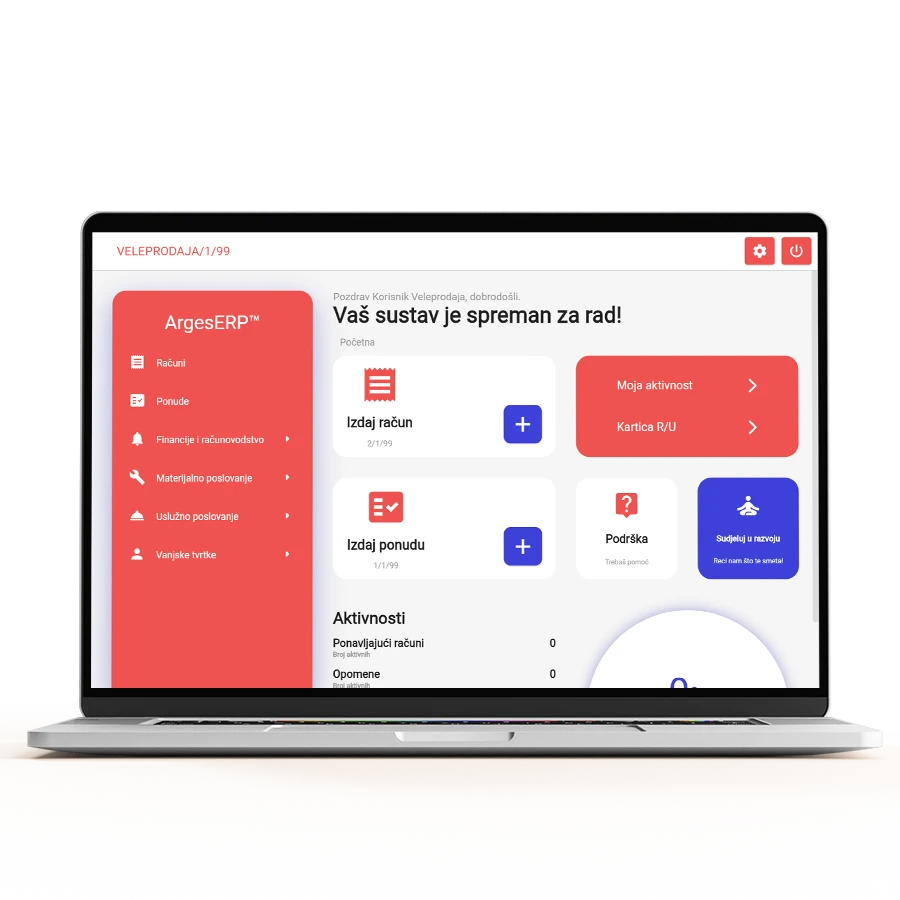
- Integrations with external systems: The infrastructure acts as a highly secure bridge to third-party services. Through the backend layer, we integrated Stripe for secure online payment processing, Arges ERP for legally compliant fiscalization and automated invoicing, as well as reliable authentication and notification (email) services.
The result is an architecture where business rules — such as pricing, slot availability, ticket status, and access permissions — are managed in one place and immediately apply across all channels.
This approach keeps the Android and iOS applications, web portals, and POS systems fast, consistent, and easy to maintain, while critical integrations such as payment processing and fiscalization are handled through a controlled backend layer.
Frontend Development: Building a Complex Business Application for Web and Mobile Devices
While the backend infrastructure acts as the brain of the ecosystem, the frontend layer represents its face and the only point of direct interaction with users.
In a modern museum environment, visitors and staff do not consume content through a single type of device. Interaction takes place across personal smartphones, dedicated tablet devices, large interactive displays within the exhibition space, and traditional desktop computers.
The greatest technical challenge in omnichannel development is avoiding fragmentation — situations where each platform looks, behaves, and functions differently. For the Croatian Sports Museum, we developed a technologically unified frontend layer that ensures a consistent, fast, and seamless user experience, regardless of the hardware being used at any given moment.
The development of client interfaces included the following technological processes and deliverables:
- Mobile application development (Flutter): For visitors’ smartphones, we developed native-feeling applications for both iOS and Android using the advanced Flutter framework. This technology allowed us to maintain a single codebase while delivering high performance, smooth transitions, and a native user experience on both operating systems.
- Dedicated tablet application (Android .apk): For the museum’s on-site installations, a dedicated Android application was delivered as a closed .apk installation package. Its code and navigation were specifically optimized for large touchscreen displays used within the museum environment, eliminating unnecessary background processes typical of personal devices.
- Web applications for kiosks and online ticketing: Using modern web technologies, we developed two specialized web applications. The first powers the interactive kiosk systems distributed throughout the museum (optimized for touch interaction), while the second serves as the public online ticketing portal, designed for high conversion rates and a secure purchase flow.
- Responsive and adaptive programming: The entire frontend layer was written to automatically detect and fluidly adapt to a wide range of screen resolutions and aspect ratios, including vertical formats such as 9:16 used by touchscreen kiosks.
The result of this omnichannel development is a cohesive digital presence. Whether a visitor purchases a ticket on a laptop at home, explores multimedia content on a large exhibition display, or listens to the audio guide on their personal smartphone, the system responds instantly and consistently.
From an engineering perspective, consolidating the technological stack (such as using Flutter) ensures that the Croatian Sports Museum benefits from simpler long-term maintenance, faster introduction of new modules, and a lower total cost of software ownership.
Seamless Integration of the CMS and Mobile Application with External Systems
No modern digital ecosystem can function as an isolated island. The true business value of a platform lies in its ability to seamlessly communicate with external financial, accounting, and hardware systems. In projects of this scale, retrofitting integrations after the fact almost always creates operational bottlenecks — such as manually transferring web sales into fiscal cash registers.
For the Croatian Sports Museum, integrations were designed as a core architectural component from day one, ensuring that transaction, ticketing, and payment data flow automatically between services in real time.
The integration process with external services and hardware included the following components:
- Online payment processing (Stripe): We implemented a deep integration with the Stripe platform, enabling fast, reliable, and highly encrypted online ticket payments through the web portal.
- Fiscalization and back-office operations (Arges ERP): Instead of separating web sales from the physical ticket office, the entire system was integrated with Arges ERP. This ensures automatic fiscalization and the issuance of legally compliant invoices for every transaction, whether it occurs online or on-site.
- Automated ticket delivery and notifications: The purchase process is completed through the automatic generation of digital tickets containing unique QR codes. The system independently manages email notifications, sending purchase confirmations and tickets directly to visitors in real time.
- Hardware validation at the entrance (Kartomat): Physical entry to the museum is directly connected to the digital database via a dedicated Kartomat validation application. The device performs real-time QR validation of tickets, communicating with the central system to instantly confirm or deny visitor entry.
The result of these integrations is a fully closed and automated operational loop. From the moment a visitor completes a payment on the web portal, to the moment the entrance device validates their QR code and the museum’s accounting department receives the fiscalized invoice in the ERP system — no manual administrative intervention is required.
The museum received a solution that significantly reduces operational workload, eliminates errors in revenue tracking, and ensures full compliance with tax and regulatory requirements.
Security and Stability of the Business Application
In systems that simultaneously process financial transactions, handle personal user data, and manage physical access control, security and stability cease to be purely technical concerns and become the foundation of business trust. Any system outage or security vulnerability in such an environment represents more than an IT issue — it directly translates into lost revenue, operational disruption at the museum entrance, and potential damage to the institution’s reputation.
For the Croatian Sports Museum, security architecture and quality assurance (QA) mechanisms were embedded into the platform’s very foundations, ensuring uninterrupted operation and strong data protection even during periods of peak visitor traffic.
The process of securing system stability and protection included the following components:
- Encrypted HTTPS communication: All data exchange between client applications (mobile devices, web portals, POS terminals) and the central database takes place exclusively through secure, encrypted HTTPS channels, preventing any interception of sensitive information.
- Granular access control and user roles: A strict Role-Based Access Control (RBAC) system was implemented. Each staff member is assigned specific permissions and user roles within the system, preventing unauthorized modifications to exhibition content or access to financial modules.
- GDPR-compliant personal data protection: The database architecture and data processing workflows — including user registration, ticket purchases, and account management — are fully aligned with GDPR requirements and strict personal data protection regulations.
- Rigorous system performance testing: Before production deployment, the entire ecosystem underwent extensive stability and performance testing. This ensured that the platform could handle many simultaneous online purchases and QR scans at entrance validation devices without slowdowns or service degradation.
The result is a highly reliable platform that provides operational confidence for the museum. Staff can manage sales and content within a strictly secured environment, while visitors’ personal and financial data remain strongly protected.
Thanks to comprehensive performance testing, the delivered platform has demonstrated its resilience — ensuring a continuous flow of visitors without the risk of system failures, even during peak attendance and large group visits.
DevOps and Implementation
Complex systems that involve multichannel delivery — including mobile applications, web portals, closed kiosk systems, POS terminals, and ERP integrations — cannot be launched by simply “pressing a button.” Coordinating all these components requires a rigorous DevOps process and controlled deployment to avoid operational disruptions or inconsistencies on launch day.
For the Croatian Sports Museum, the delivery process was managed through clearly defined implementation phases, ensuring that the solution performing flawlessly in the development environment would operate just as reliably in the real museum setting — under the hands of actual visitors and staff.
The implementation and go-live process included the following control points:
- Development in a staging environment: The entire codebase was first deployed to an isolated staging environment. Architecturally identical to production, this environment allowed us to safely test all modules and external integrations (such as payment processing and fiscalization) without any risk to real operational data.
- Beta phase and client validation: Before the public launch, the ecosystem went through a structured beta testing phase. Museum staff actively tested the administrative interface, hardware devices, and applications within the exhibition space, performing User Acceptance Testing (UAT) based on real-world usage scenarios.
- Pre-production corrections and optimizations: Based on feedback collected during the beta phase, we conducted final iterations, bug fixes, and deeper performance optimizations to ensure the system fully met expectations and was ready for production-scale traffic.
- Official release on public app stores: The mobile applications intended for visitors successfully passed the strict review processes of Apple and Google and were officially published on the global platforms Google Play and the Apple App Store.
- Internal distribution of dedicated applications (.apk): Unlike the public applications, software developed for specific museum hardware — including exhibition tablets and the entrance ticket-scanning application — was delivered through closed .apk installation packages, giving the museum full control over versions and installations within the facility.
The result of this structured approach was a fully synchronized and stress-free production launch (Go-Live). The Croatian Sports Museum received a finished digital product that operated reliably across all six operational channels from the very first minute of opening.
The DevOps processes established during the project remain a long-term asset of the platform. They ensure that the entire future roadmap and quarterly feature development can be deployed smoothly, without technical disruptions or interruptions to the museum’s daily operations.
Digital Channels: Mobile Application and Web Solutions for Visitors
While the backend infrastructure ensures stability behind the scenes, the true museum experience is defined by what visitors see and interact with directly. To bring the rich history of Croatian sport closer to a diverse audience, we developed a range of optimized digital channels.
Whether visitors explore the exhibition through their own smartphones, dedicated tablets provided within the museum, or large interactive displays mounted in the exhibition space, the objective was to deliver a unified, multimedia, and intuitive experience that seamlessly complements the physical environment of the museum.
Mobile Application Development for Visitors (Android and iOS)
In today’s museum environment, visitors expect more than passive observation of exhibits — they seek context, interaction, and autonomy in exploration. For the Croatian Sports Museum, the mobile application was not conceived as a simple digital catalogue, but as a central tool that enhances the entire visitor journey — before, during, and after the visit itself.
From a business perspective, the goal was to create a platform that simultaneously functions as a sales channel (m-commerce), a personal digital curator, and an interactive educational guide, all within an interface that remains intuitive and accessible to a broad audience.
To achieve this level of functionality, the mobile application includes the following key modules:
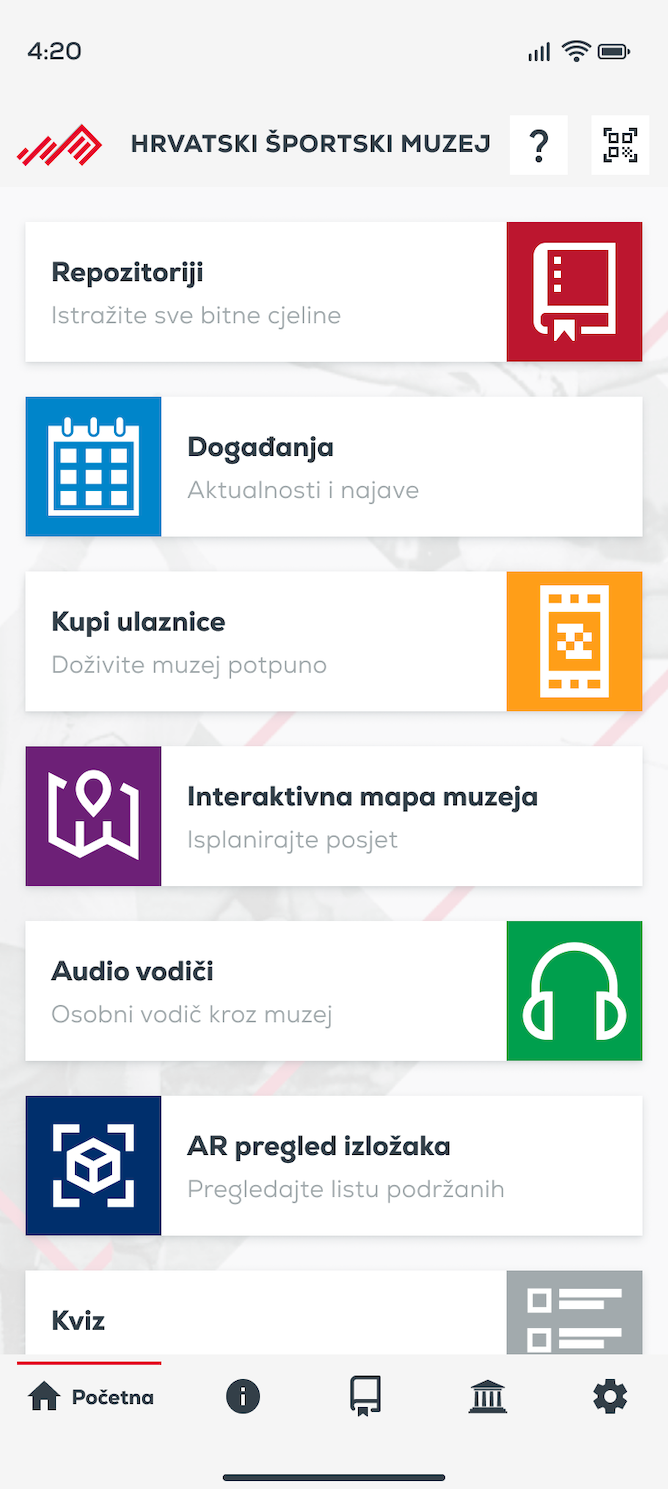
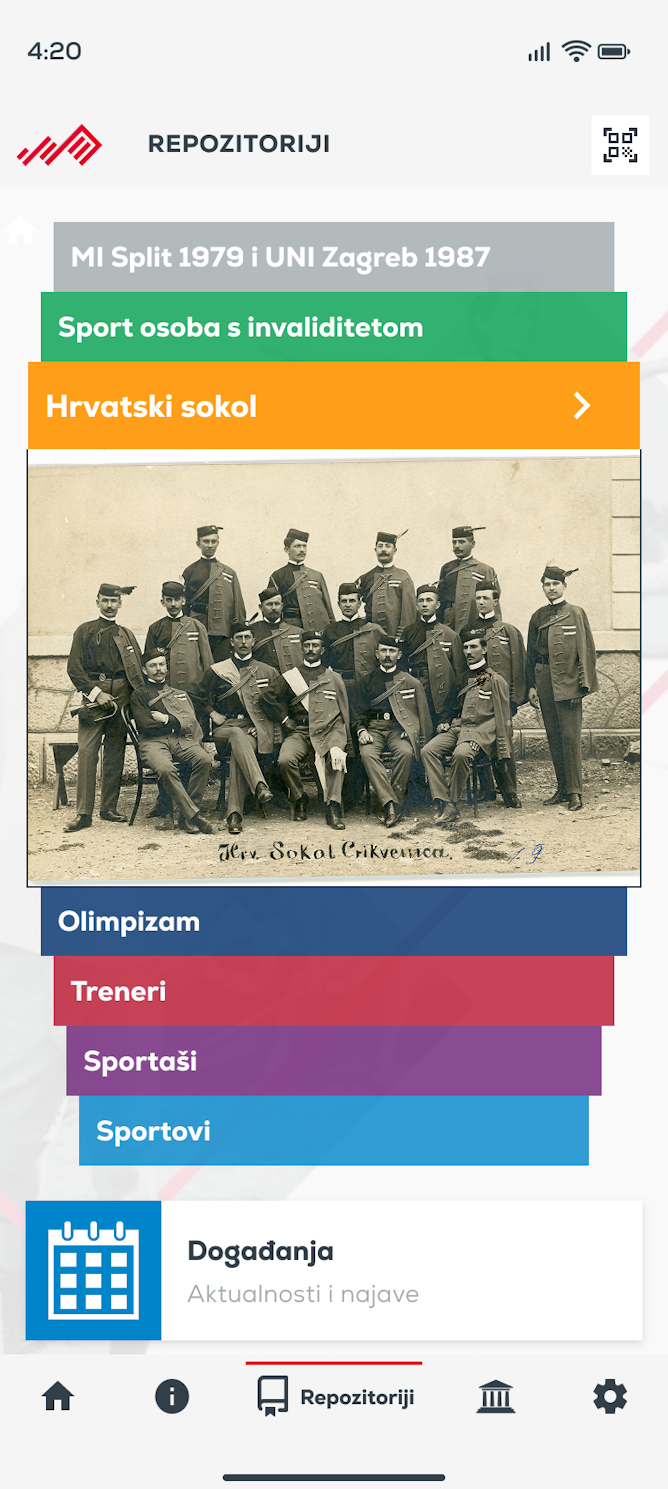
- Structured exploration of exhibitions: The application enables visitors to explore thematic sections such as Sports, Athletes, Coaches, Olympism, the Croatian Sokol movement, Sports for People with Disabilities, and historical events like the Mediterranean Games Split 1979 and the Universiade Zagreb 1987. Each section is enriched with structured text, photo galleries, and video content.
- Spatial orientation and interactive map: To simplify navigation within the physical exhibition space, an interactive map was developed with clearly marked points of interest. By selecting a location, visitors receive a detailed description, photographs, and additional contextual information about that part of the museum.
- Multimedia audio guide: An advanced audio guide allows users to listen to narration while freely navigating the application. The guide operates in the background and includes full playback controls such as play/pause, segment navigation, and a progress timeline.
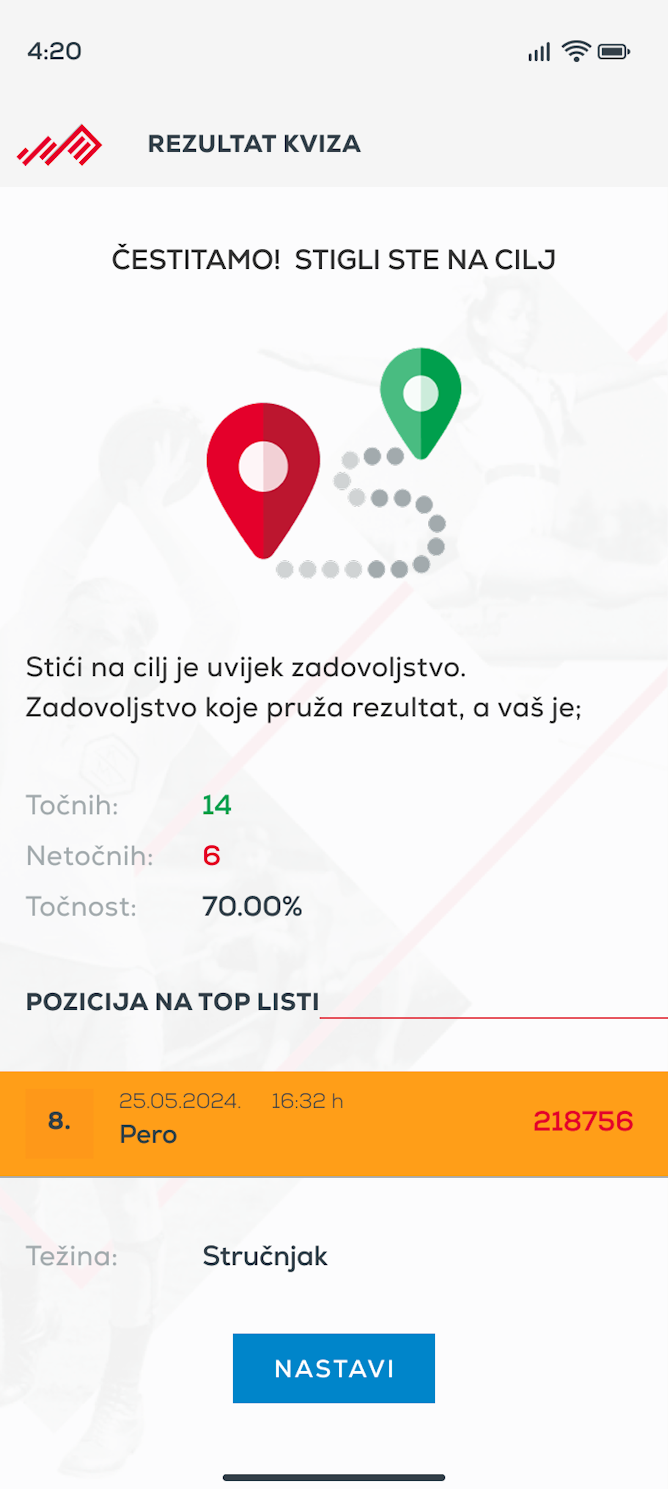
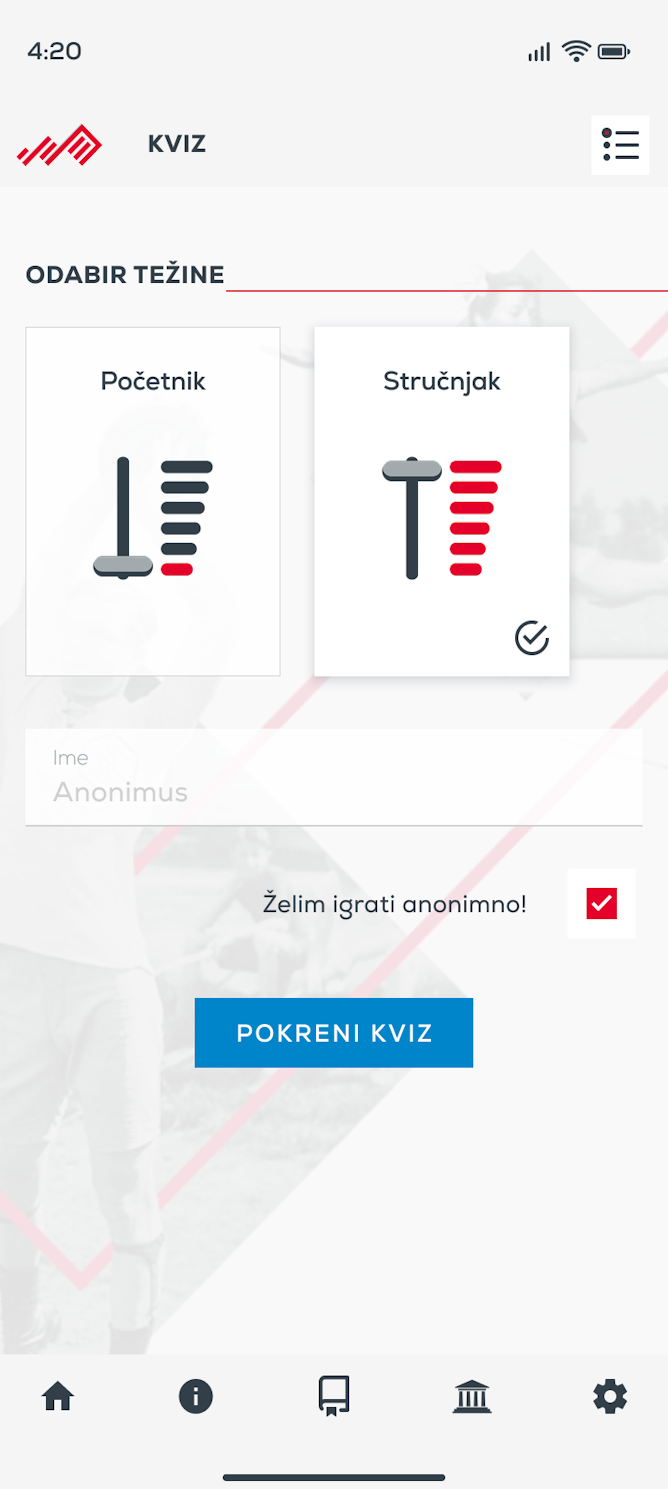
- Gamification through a quiz system: To increase engagement through educational entertainment, an interactive quiz system was integrated with multiple difficulty levels (Beginner and Expert). Questions are dynamically generated in real time from the central database.
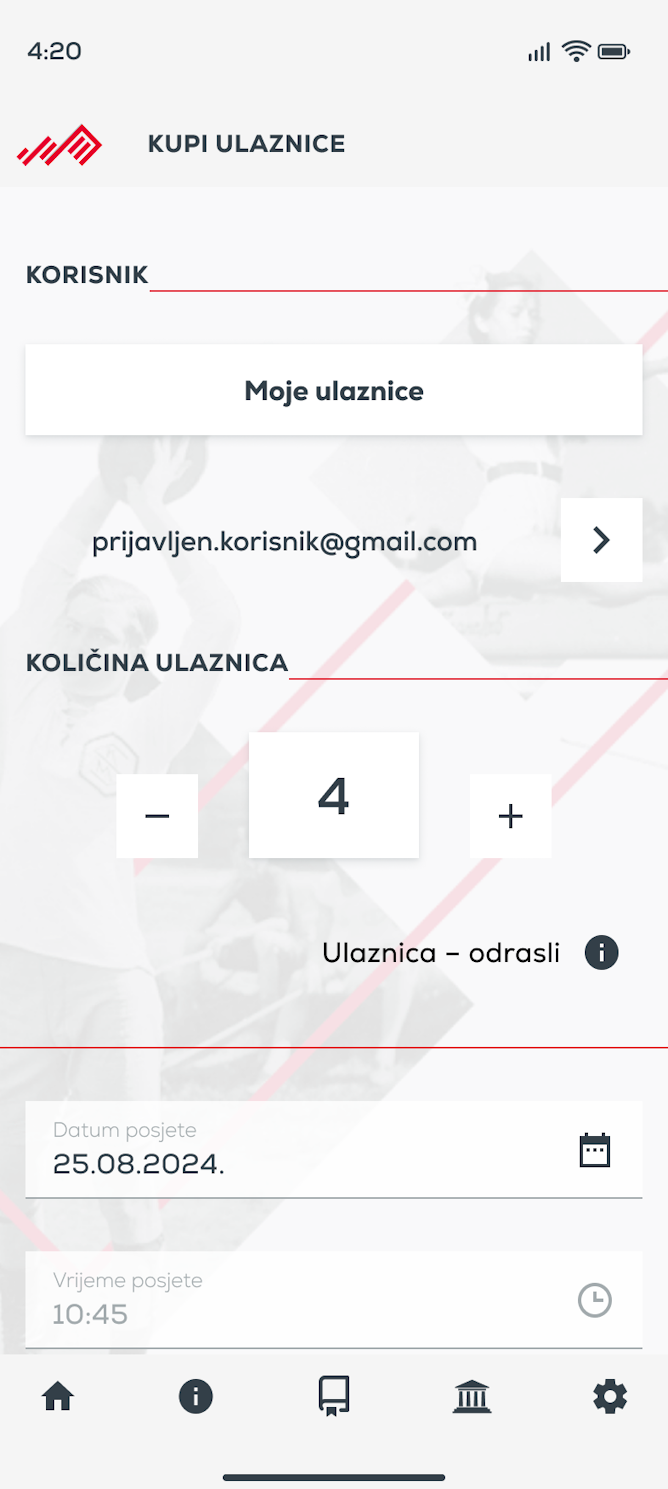
- Integrated m-commerce (ticketing): The application includes its own online ticket purchasing system integrated with the Stripe payment platform. Visitors can select the date, time slot, and number of tickets, complete the checkout process, and instantly receive a digital ticket with a QR code, which remains easily accessible in the “My Tickets” section.
- User account and privacy management: The system supports full user registration, authentication, and personal data management. All functions — including password changes and account deletion — are fully compliant with strict GDPR requirements.
- Service information and bilingual support: The application was designed as a bilingual platform (Croatian/English) from the outset and includes informational pages about the museum, opening hours, contact details, and an FAQ section, thereby reducing the operational load on the museum’s information desk.
The outcome of this development is a powerful digital product that transforms the museum’s physical space into an extended, interactive experience. From an operational standpoint, all application content is dynamically retrieved from the central CMS, eliminating the need for manual content maintenance or the release of new app versions whenever exhibition content changes.
Development of Dedicated Business Applications for Museum Tablets
Not every visitor is willing or able to use their personal smartphone during a museum visit. To ensure that no one is excluded from the enhanced digital experience, we developed a dedicated tablet application for the Croatian Sports Museum.
The goal of this solution was to create a controlled, secure, and highly optimized environment designed exclusively for use on museum-owned devices within the exhibition space. Unlike the public mobile application, the tablet version needed to eliminate administrative barriers such as registration and login processes, focusing solely on seamless content consumption on larger screens.
The technical and functional development of this specialized channel included:
- Interface optimization for large displays: The entire interface and navigation structure were architecturally adapted to the specific aspect ratios and resolutions of Android tablet devices, significantly improving the readability of textual descriptions and multimedia content compared to smaller mobile screens.
- Content-focused user experience: Full access was retained for all thematic sections, the audio guide, interactive map, and quiz modules. However, features such as online ticket purchases, order history, and personal account management were intentionally removed, as they do not add value in the on-site tablet context.
- Predefined user accounts: To eliminate delays when starting the experience, the system automatically operates through predefined system accounts (e.g., Museum1, Museum2). Visitors simply pick up a tablet and begin exploring immediately, without entering any personal data.
- Controlled .apk distribution: This software is deliberately not distributed through public app stores. Instead, it is delivered as a closed .apk installation package via a secure connection, giving the museum’s IT team full control over device installations, version management, and security.
- Operation within a closed network environment: The system was tested and optimized to operate reliably within the museum’s dedicated internal Wi-Fi infrastructure, with additional security mechanisms implemented to protect both the application and device data.
The result of this specialized development is a reliable digital tool that enables the museum to deliver a premium on-site visitor experience without the risks associated with public devices.
The tablets effectively function as a window into the museum’s always up-to-date central database, ensuring that visitors always have access to the latest exhibition information without requiring manual technical interventions on the hardware itself.
CMS-Connected Application for Interactive Kiosk Displays
Large interactive screens (kiosks) within the exhibition space represent an important point of engagement for visitors who want to explore the collection in greater depth while on-site. For the Croatian Sports Museum, the kiosk solution was developed as a web-based application designed specifically for displaying content on interactive screens throughout the museum.
The objective was not simply to replicate the mobile application, but to design an interface that fully leverages large display formats and actively draws visitor attention. This solution forms an integral part of the museum’s digital infrastructure, delivering an interactive and multimedia experience directly within the exhibition environment.
The development of this specialized component included the following technical and design adaptations:
- Adaptation for large display formats: The system allows visitors to explore thematic sections and exhibitions through an intuitive interface optimized for large screens and different display ratios (such as 16:9 and 9:16).
- Touch-optimized interface (Touch UI): The interface is designed specifically for touch interaction, with a clear content hierarchy and quick access to key information.
- Rich multimedia presentation: Visitors can browse thematic sections, view detailed descriptions of individual topics, and access multimedia content including text descriptions, photographs, image galleries, video clips, animations, and audio recordings.
- Location-based content management: The system can identify each kiosk device (for example via serial number, location, or unique device code), enabling location-specific content management. This allows a screen placed next to a particular exhibition — such as one dedicated to a specific sport — to display only the multimedia content relevant to that section.
- Security and centralized control: The web application is accessed through a secure HTTPS connection, while all data and multimedia assets are centrally managed through the CMS.
By implementing this solution, the Croatian Sports Museum gained dynamic digital information points that require minimal maintenance compared to traditional interactive installations.
The integration gives curators full editorial flexibility — any textual or multimedia update made in the CMS automatically becomes available to visitors across all interactive kiosk locations throughout the museum.
Time Machine - interactive Dispaly Cases Controlled Via Dedicated Kiosks
To turn physical artifacts into a guided, interactive experience, we developed Time Machine as part of CSM ecosystem - an installation designed for two physical cases featuring sports equipment and memorabilia tied into to key events and figures from Croatian sporting history. Each display case is operated through its own dedicated kiosk device, enabling fully independent control of content and behaviour per installation, without overlap or operational compromises.
The core interaction is simple for visitors, yet tightly controlled in execution - when a visitor selects an item on the screen, the system displays that object’s details while all other items are simultaneously pushed into the background - visualy dimmed - so the selected exhibit remains the only one highlighted. The result is a digital “spotlight” effect that directs attention and transforms the display case from static showcase into a clear, narrative-driven moment.
This interaction model is particularly effective in museum environment - visitors get instant orientation and context, while curators gain a tool to shape and guide the story without additional staffing or manual intervention at he installation itself.
Ticketing, Access Control, and ERP Integration
The commercial performance and operational flow of a museum depend directly on how effectively ticket sales and visitor capacity management are handled. Instead of relying on fragmented third-party solutions, we developed a fully integrated ticketing and access management system for the Croatian Sports Museum.
This segment of the ecosystem was designed to centralize revenue operations, ensure legal and fiscal compliance, and eliminate bottlenecks at the entrance, seamlessly connecting online and on-site sales into a single, unified operational flow.
Web Portal for Online Ticket Purchases with Automated Payment Processing
In the cultural and tourism sector, ticket sales are often handled through third-party platforms that charge commissions and create isolated data silos, making integration with accounting systems and on-site ticket offices more difficult. For the Croatian Sports Museum, such a compromise was not acceptable.
It was necessary to develop an in-house ticketing layer as a dedicated yet fully integrated component of the platform. The objective of this module was twofold: to provide visitors with a seamless and secure purchasing experience from the comfort of their homes, while equipping the museum with a powerful monetization tool and, equally important, operational control over visitor flow through capacity management.
The development of this sales channel included the implementation of the following functionalities and integrations:
- Independent and optimized web application: The portal was developed as a standalone web application integrated with the museum’s main website. It is accessible through an official subdomain and deeply optimized for both desktop and mobile devices, ensuring a high conversion rate.
- Capacity management (time slots): The portal provides a clear overview of available ticket types, including descriptions and prices, along with the option to select the desired quantity. A key operational advantage is the mandatory selection of visit date and exact time slot, allowing the museum to actively prevent overcrowding and maintain a high-quality visitor experience.
- Structured checkout and flexible payment options: Users benefit from a clear shopping cart interface and an intuitive purchase process that supports online card payments, reservation for on-site payment at the ticket office, and bank transfer options.
- Automated delivery and ERP fiscalization: After a successful purchase, the system automatically generates a digital ticket with a QR code. Through backend integration, every transaction is automatically fiscalized without any manual intervention.
The result is an end-to-end ticketing solution that allows the museum to retain full control over both revenue and customer data.
The administrative interface (CMS) enables staff to view all issued invoices, manage reservations, generate financial reports, and process potential refunds from a single dashboard. Because all pricing and availability data are managed through the central CMS, the web portal remains perfectly synchronized with the rest of the digital ecosystem and — most importantly — directly integrated with the QR scanning application at the museum entrance.
Integration of the Point-of-Sale (POS) System
The implemented POS system represents a direct extension of the centralized platform into the museum’s physical point of sale. This approach eliminates duplicated inventory records and price inconsistencies — common issues in fragmented retail setups.
We developed a custom POS solution as a standalone yet deeply integrated component of the overall ecosystem. Its purpose was to unify ticket sales, souvenir shop operations, and legally compliant fiscalization into a single, streamlined operational workflow.
The development and implementation of the POS system included the following business modules:
- Unified sales of goods and services: The POS interface was designed for maximum operational speed, enabling staff to simultaneously sell different types of services (tickets and guided tours) as well as physical merchandise (souvenirs, publications, promotional materials).
- Automated fiscalization: The integrated system ensures instant invoice issuance and full compliance with the museum’s regulatory fiscalization requirements, completing the entire transaction cycle directly at the point of sale.
- Comprehensive inventory and stock management: The system goes beyond basic payment processing by providing advanced tracking of quantities and financial values across categories (services vs. retail items). Modules were implemented for stock intake records, partner database management, product and service catalogues, and periodic inventory audits.
- Financial analytics and automated reporting: The backend system maintains precise revenue records and automatically generates daily reports and summaries, eliminating manual calculations and significantly simplifying the workload for the accounting department.
The implementation of this custom POS solution eliminates operational silos entirely. Because the POS system is directly connected to the online ticketing portal and the central CMS, the museum gains a single, accurate real-time overview of all sales, both online and on-site.
The same pricing structures, ticket types, and availability logic are automatically applied across the entire ecosystem, without manual reconciliation. As a result, the museum now operates on a platform that is fully prepared to support its commercial operations both operationally and in terms of regulatory compliance.
Ticket Scanning Application (Entrance Validation System)
Physical access control represents the final — and operationally most sensitive — step in the visitor journey. No matter how well the ticket purchasing process is optimized, a bottleneck at the museum entrance can quickly undermine the visitor experience and create security risks within the venue. Generic scanners that synchronize with the database only periodically leave room for misuse, such as repeated entry using the same ticket.
To prevent this, we developed a dedicated ticket-scanning application for the Croatian Sports Museum, designed to run directly on entrance validation devices (ticket kiosks). The goal was to create a reliable, fast, and fully automated validation system that communicates with the rest of the digital ecosystem in real time.
The development and implementation of this access-control module included the following technical features:
- Dedicated Android application development: The software was specifically engineered for use on specialized entrance devices equipped with screens up to 10 inches, the Android operating system, Wi-Fi connectivity, and integrated QR code scanners. The application is distributed and installed in controlled conditions via a secure .apk installation package.
- Real-time ticket validation: The system enables extremely fast and reliable verification of both digital tickets (displayed on smartphones) and printed tickets through QR code scanning. Through continuous communication with the central database, the application instantly verifies the ticket’s status, preventing fraudulent or repeated entries.
- Visual and status-based signalling: The application clearly communicates the entry status to both visitors and museum staff. Valid tickets are approved instantly, while already-used or invalid tickets are blocked with clear visual and audio signals. In the event of irregularities (such as damaged QR codes or incorrect time slots), the system is designed to allow immediate intervention by museum staff.
- Automated visitor flow management: To prevent queues from forming at the entrance, the application includes an advanced feature that automatically initiates the next scan immediately after a successful validation. This ensures a continuous and smooth flow of visitors without requiring manual device resets by staff.
With the delivery of this application, the Croatian Sports Museum successfully closed the entire operational loop of ticket sales and visitor access control. The entrance validation device is not an isolated piece of hardware, but a deeply integrated component connected to the online ticketing portal, the visitor mobile application, and the on-site POS system.
This architecture ensures a single, centralized record of all valid and redeemed tickets in real time, giving museum management a precise overview of the number of visitors inside the exhibition space at any moment.
Operational Hub: Managing Content Across the Mobile Application and the System
The greatest challenge of digital transformation is not merely implementing technology but ensuring that the client can independently manage the system over the long term.
To prevent the Croatian Sports Museum from becoming dependent on external IT resources for everyday updates, it was essential to establish a central operational environment from which museum staff can manage content, sales, and overall platform administration.
Administrative Interface (CMS): Centralized Integration of the CMS and Business Applications
For the long-term sustainability of a multi-channel system, the museum requires a single operational control centre. In practice, many institutions become captive to their own technology because even minor content updates require the involvement of external contractors. To avoid this dependency, the Administrative Interface (CMS) was developed as a centralized web-based system for managing content and critical operational data—allowing museum staff to perform everyday updates quickly, securely, and without relying on development teams.
The development of this management hub included the integration of the following modules and functionalities:
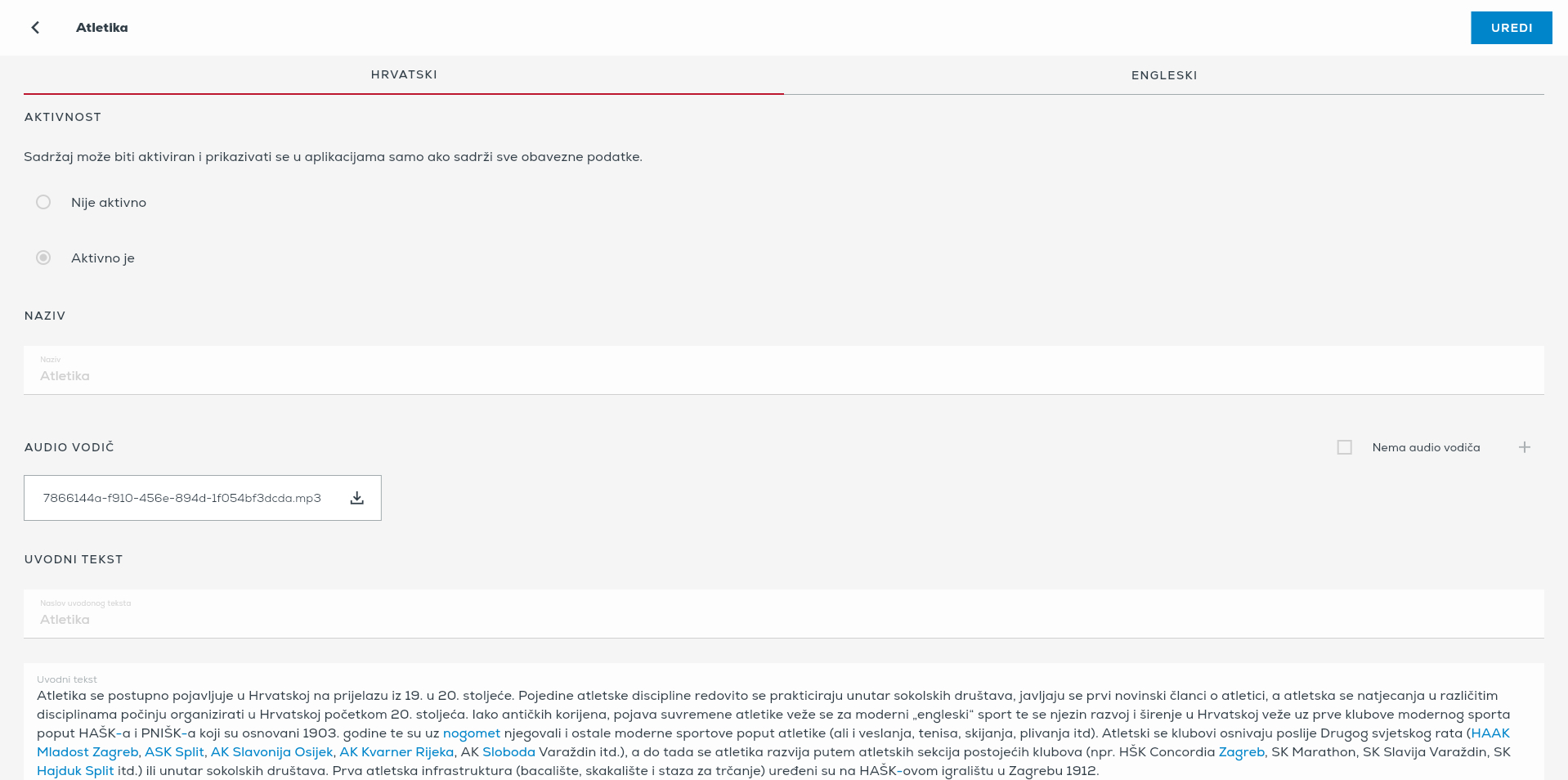
- Comprehensive management of exhibition content: The system enables the creation, editing, and organization of all data displayed across the mobile application, tablet application, kiosk web application, and the online ticketing portal. This includes structured management of thematic sections through groups, subgroups, exhibition spaces, and textual descriptions, as well as the distribution of rich multimedia such as photographs, galleries, videos, and animations.
- Administration of educational tools: The CMS directly manages audio guides by defining their title, description, duration, and segmentation. In addition, it includes full administration of the quiz system, covering the management of question-and-answer databases, difficulty levels, and thematic categorization.
- Sales control and financial reporting: The operational module allows administrators to manage ticketing—from defining ticket types and prices to controlling time-slot availability and reviewing purchases and reservations. The system also provides an overview of issued invoices, tracking of ticket statuses, and administrative actions such as cancellations and report generation, all deeply integrated with the ERP system.
- Security and access control management: The interface is accessible exclusively via a secure web connection (HTTPS) and is optimized for use in modern web browsers. To protect operational data, a strict role-based access control system has been implemented, defining different permission levels (Superadmin/Admin).
- Real-time synchronization: The most significant technological and operational advantage of this CMS lies in its architecture. All changes made within the CMS are automatically synchronized and instantly reflected across all connected applications and portals. This eliminates the need for additional technical intervention or waiting for new application versions to be published in app stores.
The administrative interface functions as the central control point of the museum’s digital ecosystem. The result is a sustainable platform that enables museum staff to independently manage content while maintaining clear role definitions, secure administration, and consistent distribution of information across mobile applications, kiosk devices, web ticketing systems, and the POS environment.
Conclusion: Digital Transformation Through the Development of Business Systems and Applications
Digital transformation in cultural and sports institutions should not be reduced to isolated applications. For the Croatian Sports Museum, we delivered an integrated system that combines the development of business applications, Android and iOS mobile applications, web-based ticketing, entry control, and POS operations—all built on a single source of data and centralized backend logic.
A key value of the project lies in the controlled management of content and sales through the CMS, supported by reliable integrations for payment processing and fiscalization.
Through this project, we achieved three essential business objectives:
- Centralized control: Content, pricing, and user permissions are managed from a single point (CMS), eliminating operational fragmentation and reducing dependence on external IT providers for routine updates.
- Business automation: By integrating Stripe payment processing and Arges ERP fiscalization with the POS system and web portal, we created a closed financial ecosystem that operates without the need for manual reconciliation.
- A premium visitor experience: Through interactive maps, audio guides, and rapid QR validation at the entrance, visitors are provided with an experience that sets new standards in the museum industry.
If you are looking for a partner capable of delivering a complete end-to-end platform from the ground up — from complex system architecture and UX/UI design to mobile and web channels, hardware integrations, and a sustainable long-term maintenance model—this project clearly demonstrates our technical breadth and operational maturity. The solutions we build are not designed merely to look good; they are engineered to reliably manage your operations day after day.
At RedCode, we don’t just build applications—we create digital ecosystems that enable your organization to grow.
Contact us and turn your vision into a stable digital reality.
Key Results
Technologies







Projects from the category